
Cornell Forge is an ISO 9001:2015-certified company that specializes in forging design, tooling, and metal forging services to create custom-engineered products and parts. We offer a diverse array of metal forging capabilities, including closed die hot forging, as well as finishing and value-added services that simplify your supply chain. Our turnkey forging solutions are part of our commitment to excellent customer service.
If you need custom-made metal parts, Cornell Forge is here to help during every stage of design and production. Start the process by determining whether forging or casting processes are a better fit for your specifications. The difference between casting and forging comes down to the shaping process. Casting reduces metals to a molten form while forging shapes the metal workpiece while in a solid state.
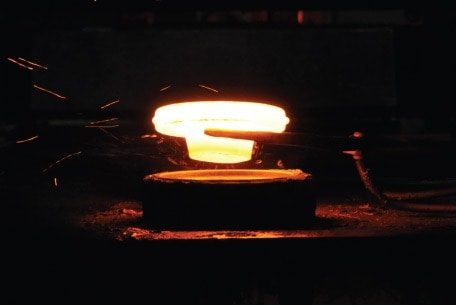 Forging processes involve rolling, pressing, hammering, or otherwise shaping metal billets while still in a solid form into a precise shape through mechanical force. The heating and deformation process refines the metal's internal grain structure by allowing metallurgical recrystallization to occur, giving a uniform structure throughout the metal form. This process strengthens the metal and makes it more resistant to impact and shear damage.
The internal grain structure conformity is the core benefit of forged metal that gives it many of its advantages over cast and plate metal components. Because the flow of the grain aligns with the geometry of the shape, it becomes very tough and resistant to damage.
Forging processes involve rolling, pressing, hammering, or otherwise shaping metal billets while still in a solid form into a precise shape through mechanical force. The heating and deformation process refines the metal's internal grain structure by allowing metallurgical recrystallization to occur, giving a uniform structure throughout the metal form. This process strengthens the metal and makes it more resistant to impact and shear damage.
The internal grain structure conformity is the core benefit of forged metal that gives it many of its advantages over cast and plate metal components. Because the flow of the grain aligns with the geometry of the shape, it becomes very tough and resistant to damage.
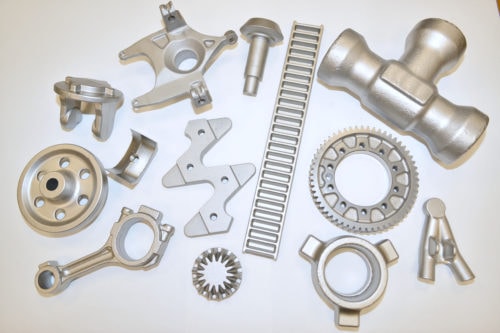 In metal casting, molten metal is poured directly into an existing mold, where it cools and hardens into the mold's shape. Casting processes can use a wide variety of different mold types depending on the size of the order and the complexity of the part. While metal casting has been used for centuries, today's manufacturers generally reserve this process for parts that are too large or unwieldy for metal forging. Casting is a superior method for more complex geometries that are difficult to achieve through the application of force alone.
At Cornell Forge, we can forge simple and complex parts that are up to 18 inches long and 100 pounds in weight. Some die forgings can even be made that weigh up to 5000 pounds or more. However, casting is often more appropriate for parts of this size.
In metal casting, molten metal is poured directly into an existing mold, where it cools and hardens into the mold's shape. Casting processes can use a wide variety of different mold types depending on the size of the order and the complexity of the part. While metal casting has been used for centuries, today's manufacturers generally reserve this process for parts that are too large or unwieldy for metal forging. Casting is a superior method for more complex geometries that are difficult to achieve through the application of force alone.
At Cornell Forge, we can forge simple and complex parts that are up to 18 inches long and 100 pounds in weight. Some die forgings can even be made that weigh up to 5000 pounds or more. However, casting is often more appropriate for parts of this size.
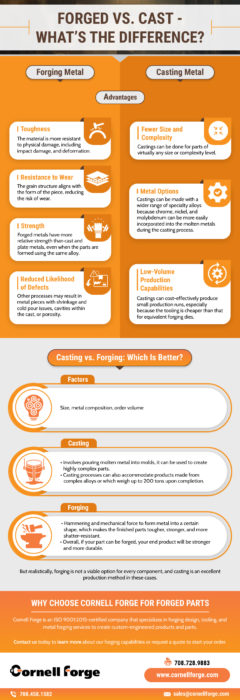 Both forging and casting processes can be used to create high-quality metal parts. However, each method works best for different types of products based on the size, metal composition, order volume, and other factors.
Because casting involves pouring molten metal into molds, it can be used to create highly complex parts. Casting processes can also accommodate products made from complex alloys or which weigh up to 200 tons upon completion. Forging processes use hammering and mechanical force to form metal into a certain shape, which makes the finished parts tougher, stronger, and more shatter-resistant. Overall, if your part can be forged, your end product will be stronger and more durable. But realistically, forging is not a viable option for every component, and casting is an excellent production method in these cases.
Both forging and casting processes can be used to create high-quality metal parts. However, each method works best for different types of products based on the size, metal composition, order volume, and other factors.
Because casting involves pouring molten metal into molds, it can be used to create highly complex parts. Casting processes can also accommodate products made from complex alloys or which weigh up to 200 tons upon completion. Forging processes use hammering and mechanical force to form metal into a certain shape, which makes the finished parts tougher, stronger, and more shatter-resistant. Overall, if your part can be forged, your end product will be stronger and more durable. But realistically, forging is not a viable option for every component, and casting is an excellent production method in these cases.
Advantages of Forging Metal
Forging processes involve rolling, pressing, hammering, or otherwise shaping metal billets while still in a solid form into a precise shape through mechanical force. The heating and deformation process refines the metal's internal grain structure by allowing metallurgical recrystallization to occur, giving a uniform structure throughout the metal form. This process strengthens the metal and makes it more resistant to impact and shear damage.
The internal grain structure conformity is the core benefit of forged metal that gives it many of its advantages over cast and plate metal components. Because the flow of the grain aligns with the geometry of the shape, it becomes very tough and resistant to damage.
Advantages
Here's a quick breakdown of the advantages of forged metal to consider when choosing the right metal forming process for your component order:- Toughness: The material is more resistant to physical damage, including impact damage, and deformation.
- Resistance to Wear: The grain structure aligns with the form of the piece, reducing the risk of wear.
- Strength: Forged metals have more relative strength than cast and plate metals, even when the parts are formed using the same alloy.
- Reduced Likelihood of Defects: Other processes may result in metal pieces with shrinkage and cold pour issues, cavities within the cast, or porosity.
Advantages of Casting Metal
In metal casting, molten metal is poured directly into an existing mold, where it cools and hardens into the mold's shape. Casting processes can use a wide variety of different mold types depending on the size of the order and the complexity of the part. While metal casting has been used for centuries, today's manufacturers generally reserve this process for parts that are too large or unwieldy for metal forging. Casting is a superior method for more complex geometries that are difficult to achieve through the application of force alone.
At Cornell Forge, we can forge simple and complex parts that are up to 18 inches long and 100 pounds in weight. Some die forgings can even be made that weigh up to 5000 pounds or more. However, casting is often more appropriate for parts of this size.
Advantages
Metal casting is a suitable alternative to forgings in some circumstances because of these unique advantages:- Fewer Size and Complexity Restrictions: Castings can be done for parts of virtually any size or complexity level.
- Metal Options: Castings can be made with a wider range of specialty alloys because chrome, nickel, and molybdenum can be more easily incorporated into the molten metals during the casting process.
- Low-Volume Production Capabilities: Castings can cost-effectively produce small production runs, especially because the tooling is cheaper than that for equivalent forging dies.
Casting vs. Forging: Which Is Better?
Click to Expand
